Accounting software integration is a struggle for tax and accounting firms, but it doesn’t have to be (2026)
Most tax and accounting firm are running disconnected systems with no way to coordinate work between them. You need to get your accounting software integration


Most tax and accounting firms inherited their tech stack, and it’s created a real headache because nothing connects.
For example, a firm may use CCH for UK compliance work, DATEV for German filings, and somewhere underneath all of it, a client's own ERP that the engagement team has to log into separately every time they need a balance sheet figure. None of these systems were designed to work together. The result is an operation where the tools work, but the operation between them doesn't.
This is the accumulated result of organic growth, client preferences, and two decades of acquisitions. Each one arrived with its own platform commitments and its own version of how a tax return gets processed. The systems work individually, but work doesn't flow between them. Instead, someone has to carry data manually from one platform to the next, then hopefully remember to update a tracker when they're done.
How fragmented the problem really is
Some firms have attempted to build proprietary platforms from scratch to bridge the gaps that off-the-shelf systems couldn't close. But bespoke internal tools are expensive to build and slow to roll out. Every time a firm acquires a new practice or onboards a client running different systems, the internal platform needs updating. The dev team often ends up in a permanent cycle of patching an integration layer that's always one acquisition away from falling over.
Most firms don't have the time or budget to go down the DIY road. Research by Rightworks found that 60% of accounting firms describe their technology as disconnected systems with inconsistent processes. That means the majority of firms in this space are managing their compliance calendars, period-end processing, and work in progress reviews across accounting practice management software and billing tools that weren't designed to share data.
All this takes a serious toll on margins. A reconciliation workflow that should take an hour takes a day because the data lives in three different systems and none of them talk. Or, a lock-up days report requires someone to manually consolidate figures from the practice management system, the billing stack, and the client ERP. And when something goes wrong mid-cycle, there's no single place to look, the information is spread across five platforms and someone has to go on an pilgrimage to find it.
The offshore dimension heightens the issue
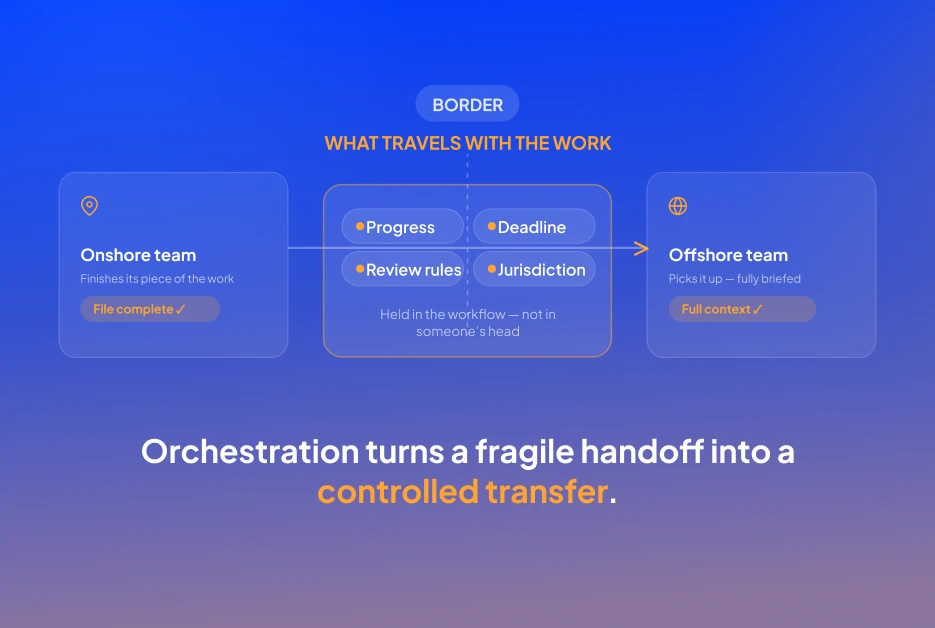
Offshore delivery has become central to how the largest tax and accounting firms manage cost and capacity. However, when there's no orchestration layer managing the transition, every cross-border handoff becomes a potential breakpoint.
For instance, let’s imagine UK team finishes their piece and transfers a file. The offshore team then picks it up with no context about what's already been done, what still needs doing, or which review rules apply to this client in this jurisdiction. Add multi-jurisdiction complexity and it gets harder still. Some filings run on business days, others on calendar days. Some clients require a senior review step before sign-off while others don't. When that logic lives in someone's head rather than in the workflow itself, handoffs become the most likely place for something to go wrong.
Capacity planning gets harder too because without a single view of who's working on what across onshore and offshore teams, managers are making resourcing decisions based on what they were told in the last status call. By the time they discover the offshore team is under-resourced on a particular filing cycle, the SLA deadline has already passed.
PE consolidation turns a problem into a crisis
A fragmented tech stack is a manageable problem at one practice. But it becomes a serious ceiling on profitability when private equity arrives and the acquisition programme starts.
Xeinadin's attempted £1bn+ exit collapsed in early 2026 partly because buyers had priced the cost of integrating over 100 fragmented practices and concluded it wasn't worth it. That's the endpoint of a fragmented consolidation strategy, a portfolio of businesses that looks like scale on paper, but not on the balance sheet.
TMF Group's $43M orchestration result

TMF Group runs accounting, corporate secretarial, HR, and capital services across more than 50 countries, with over 13,000 staff. Before they moved to Enate, client requests were coming in through email, self-service portals, and call centre tickets. Work lived in pockets across different systems, and the result was crossed wires, duplicated effort, and no reliable way to see where any engagement stood.
TMF brought all incoming service requests under one roof, connecting Enate to their existing stack including their client platform and RPA automation tools. That gave their 4,500 users a single place to work from and gave leadership the visibility they'd never had before.
Felipe Araya, Global Head of Operations at TMF, told us: "Implementing Enate’s process orchestration solution has given me full visibility and control of my operations. Even when travelling, I'm able to access the platform, identify potential client risks and request internal action. By the time I land in another country, the risk is mitigated, and any issues are resolved. The problem of 'not knowing' the status of work has become a thing of the past."
The result was a $43M margin improvement, a 22% increase in operational efficiency, a 22% reduction in process cycle times, and a 33% improvement in client satisfaction. TMF's teams are handling more work at lower cost and completing it faster, without replacing any of their existing platforms.
Why Enate?
Enate sits above your existing tech stack and orchestrates work across the people and platforms that deliver your services. It plugs into CCH, DATEV, NetSuite, or a client's own ERP, deploys in six to eight weeks, and needs no coding to get up and running. Work is routed to the right person based on capacity, skill, and the rules that apply to that client and jurisdiction. When a firm is acquired, its workflows onboard into the same model without rebuilding integrations from scratch, which is what turns a portfolio of fragmented practices into something that actually runs like one business.
If you're managing tax and accounting services across multiple practices, platforms, and delivery locations, book a demo to see how Enate gives your operations team the visibility to run all of it.