What to do when the board wants AI but your operating model isn't ready (2026)
Most AI pilots never reach production because the operating model isn't ready. Enate's James Hall on why agentic AI governance is the missing piece.


Walk into any board meeting today and the expectation is clear. The word on everyone’s lips is AI. Specifically, productivity gains from using AI and Agentic. But the reality for most companies right now is that a lot of AI workflows are being trialled, while very few have been rolled out across the business. In fact, research by IDC shows 88% of AI proof-of-concepts never make it to widescale deployment.
AI governance and Agentic governance is the missing piece. I'm talking about the systems and accountability structures that make sure AI operates reliably in production. Without it, no amount of investment is going to move the needle on enterprise AI adoption.
The Wild West problem
I’ve spent my career in technology, and AI is the most rapidly evolving space I've ever witnessed. However, the tech is still relatively niche, and not everyone is willing to embrace it. This means AI literacy varies wildly within teams, never mind across the whole workforce.
This mix of AI literacy makes it hard to put a stake in the ground and say "this is how we take the company forward." If the donkey's moving, it's hard to pin the tail on it.
And if you're in a services company, you've got internal change challenges and inertia to overcome before you can adapt.
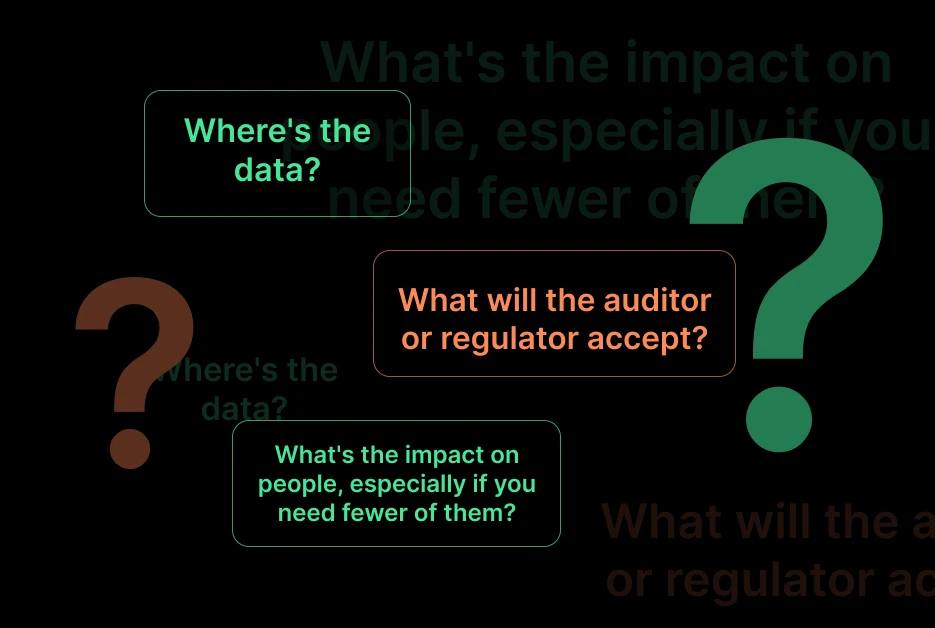
Fundamental questions need to be answered first, such as…
Where's the data?
What will the auditor or regulator accept?
What's the impact on people, especially if you need fewer of them?
Those are the questions an AI governance framework answers.
The AI proliferation trap
There are parallels between the current AI boom and the RPA era. Back then, everyone got the budget and permission to try things, but they still had to set up centres of competence to evaluate the business case for each experiment. Experimentation matters, but at some point you need a way to judge what's sticking. And the ROI models for AI aren't mature yet.
That evaluation is the next phase of the AI era, and it's what will make AI pay. It's already starting. We recently spoke to a CIO who was about to embark on an enterprise-wide purge of AI initiatives, cutting the experiments that weren't earning their place so the budget could go to the ones that were.
The accountability black hole
When something goes wrong with a client deliverable, there's typically a person accountable for it. AI agents create a black hole of uncertainty instead. You can't say with certainty why an agent made a mistake, or whether it'll happen again. And when clients ask where things went wrong, "our AI agent must've hallucinated" won't cut it as an answer.
That's where AI governance matters. You need to lay a foundation that nails down what's deterministic and what's validated against a person saying, “yes, I vouch for this”. And you need an audit trail of how you got there.
The better that AI governance is, the better the interface by which you engage agents and put them to work. And the simpler and more specific the task you give an AI agent, the better it'll perform.
The process debt problem
Before any of this can work, there's a deeper reckoning most organisations haven't had. Their processes weren't built for AI. Standard operating procedures were designed for legacy systems, not agents. And plenty of processes aren't documented at all. HFS Research recently found that just 46% of enterprise processes are formally documented and governed through standard operating procedures.
Data readiness is the other piece. Plenty of organisations have pressed ahead with AI without it. The same HFS study found only 33% of enterprise data is actually AI-ready. POCs end up getting built on data sets that are perfect… Except they're not real. Once you try to go into production, all the old problems with accessing actual data resurface. It's one of the reasons things aren't getting into production as fast as people would like.
What an AI governance framework actually looks like
Three things need to be in place here: data, process, and resource.
Data
According to a Gartner report, poor data quality costs organisations an average of $12.9 million a year. AI will only amplify that problem without the right guardrails in place.
How you organise and position your data is going to be key here. It needs to be easy for both humans and agents to find and decipher. And unless you tell it as part of the data, an agent won’t know that a client interaction from last week matters more than one from seven years ago.
Process
Processes need rebuilding from the bottom up, with agents in mind. Ask:
- What's the output of this process?
- What are you trying to do, by what time, and for whom?
- What data and resource do you need to deliver it?
Then redesign the process around the answers. Build it to go into production, so it doesn't end up as a diagram on a shelf
Resource
The most important question to ask at every stage of a process is going to be: is this a point where you need a human in the loop? And it's always a tightrope walk between efficiency and quality. The more critical the deliverable, the more human sign off you'll want built into the workflow.
Get these three parts of the equation right and the upside is real. TMF Group worked with Enate to do exactly this across 6,000 users in 95 countries, delivering a $43M margin improvement and 22% efficiency gains.
Start with the future, work backwards
Picture your business three or four years from now. Most of the routine work runs through agents, but you’ll still need someone to sign off on it. The AI governance framework is what defines when human judgement is needed and what form it takes.
But governance needs an owner, and right now most businesses don't have one. That's why the Chief AI and Digital Officer role exists.
It's worth adding that role to your org chart. Deloitte found that organisations with mature AI governance frameworks see a 28% rise in staff actually using AI tools, and revenue growth nearly 5% higher than the rest.
Take care of all of this, and you'll walk into the next board meeting with an operating model AI and Agentic can thrive in, rather than another stalled POC.




.avif)